The spoiler effect in elections can be frustrating. I wish my preferred candidates would not "steal" votes from each other. And I wish I would never have to lie about my preferences for my vote to count.
Elections are unfair. How to prevent dishonesty as a winning strategy?
Number the boxes in order of your choice
- 4Hayden Kelly
- Lesley Poole
- 4Marley Bennett
- 3Lesley Mills
- Erin Fraser
- 1Brett Nielsen
- 4Noel Curry
- 2Vic Levy
- Tanner Fleming
- 2Glen Hoffman
Let's discover several election systems which better reflect voters' opinions. This article partially answers the question: how to fairly gather the preferences of a group of voters to select a winner?
No information here is new. Most content is inspired from the Wikipedia article on electoral systems, the presentation of Practical Voting Rules by Dr Felix Brandt, and videos from CGP Grey and Science4All.
The problem space
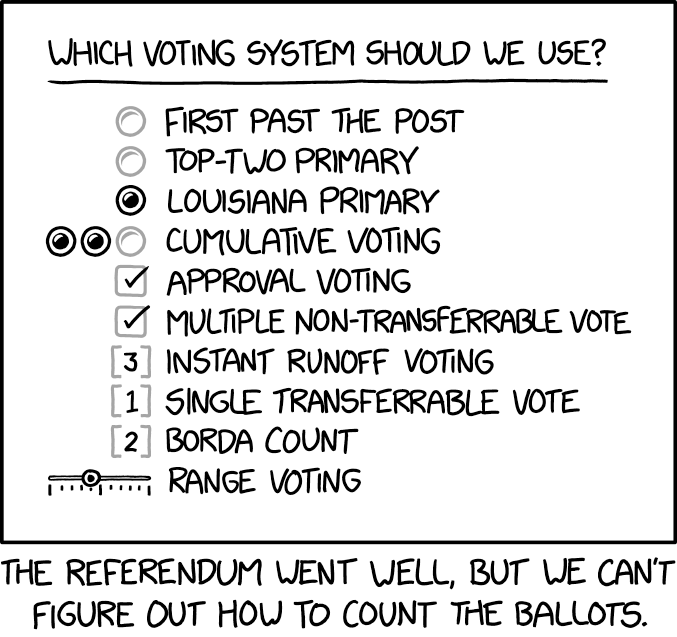
In real-world elections, we are generally unable to express our full preference order. Most of the time, we can only select one single candidate. This leads us to lie about our preferences — for example when a vote would be "wasted" on an underdog (the spoiler effect).
Elections could be fairer if voters could indicate their full preference order. It could then be taken into account and better reflect people's opinions. Also, entering all preferences in one ballot allows us to compute multi-round elections at once, without forcing voters to cast multiple ballots.
There are two main ways to record voters' opinions:
- ranked voting: each voter submits an order of preference between candidates
- cardinal voting: each voter grades candidates on a scale
Even though cardinal voting has many supporters, it enables tactical voting: one can benefit from lying. This article focuses only on ranked voting.
Voters rank alternatives in a sequence, possibly with ties. The ballots accept ties: if voters are indifferent between two candidates, they can place them at the same rank. For simplicity, ties and tie-breakers are ignored in the examples below.
5 simple voting systems
Let's consider an election with 100 voters and 5 candidates: 🐸Frog, 🐷Pig, 🦁Lion, 🐻Bear, and 🐭Mouse — using the voting scenario invented by Michel Balinski.
The voters are gathered in 6 groups, each sharing the same preference order. Read the table as "33 voters rank Frog first, then Pig, then Lion, then Bear, and finally Mouse last; 16 voters rank Pig first, then Bear, then Lion; etc."
| 33 | 16 | 3 | 8 | 18 | 22 |
|---|---|---|---|---|---|
| 🐸 Frog | 🐷 Pig | 🦁 Lion | 🦁 Lion | 🐻 Bear | 🐭 Mouse |
| 🐷 Pig | 🐻 Bear | 🐻 Bear | 🐭 Mouse | 🐭 Mouse | 🦁 Lion |
| 🦁 Lion | 🦁 Lion | 🐷 Pig | 🐷 Pig | 🦁 Lion | 🐷 Pig |
| 🐻 Bear | 🐭 Mouse | 🐸 Frog | 🐻 Bear | 🐷 Pig | 🐻 Bear |
| 🐭 Mouse | 🐸 Frog | 🐭 Mouse | 🐸 Frog | 🐸 Frog | 🐸 Frog |
We can compare several voting systems using this preference profile.
Did you notice? The 5 voting systems below give 5 different winners while the voters don't change their preferences! 🤯
First past the post
Only the first choice of each voter matters. 🐸Frog wins with 33 votes. Used in the USA, UK, Canada.
This feels unfair: Frog is ranked last by 56% of voters. Those 56% could agree before the election on Mouse as their preferred alternative to prevent Frog from winning.
Two-round run-off
If no candidate gets 50% in round 1, the top two compete again. 🐭Mouse wins with 64% in the final round. Used for presidential elections in 47 countries (France, Finland, Russia…).
But Mouse is still the second-most disliked candidate: if you remove the top-disliked Frog, 52% of voters rank Mouse last.
Instant run-off
The candidate with the fewest first-choice votes is eliminated each round. Lion is eliminated first, then Pig, then Mouse, then Frog. 🐻Bear wins. Used in Australia, Ireland, India.
Knowing the outcome, some groups could change their ballots to prevent Bear's election — strategic voting remains possible. For example, the 33%-group could rank Pig first, electing Pig instead of Bear.
Coombs' rule is a similar method where the candidate ranked last by the most voters is eliminated each round — it would elect Pig here.
Borda's rule
Each candidate earns points per rank: 5 pts for 1st, 4 pts for 2nd, etc. 🐷Pig wins with 347 points (Lion is second with 344).
With such a close race, voters have strong incentives to rank their true preference last to hurt rivals — this kind of behaviour often pushes political systems towards bipartisan outcomes.
Copeland's method
Counts victories in all pairwise duels. 🦁Lion wins with 4 victories — it beats every other candidate head-to-head. This is called a Condorcet winner.
Wins: 🐸 Frog: 0 · 🐷 Pig: 3 · 🦁 Lion: 4 · 🐻 Bear: 2 · 🐭 Mouse: 1
Interestingly, Lion was never selected by the four real-world methods above, despite winning every individual duel.
Preferences graph helps to visualize duels
To visualize duels, it is useful to represent voters' preferences as a directed graph.
The first group of voters (33%: Frog → Pig → Lion → Bear → Mouse) can be represented like this:
Adding the preferences of all 100 voters, we get the full graph:
This is messy. We can simplify by combining opposed edges into a single net edge:
🦁Lion, with all edges pointing outward, is the Condorcet winner (winner of all duels).
Condorcet winners and the Condorcet paradox
A Condorcet winner beats every other candidate in a head-to-head comparison. You might think: just always pick the Condorcet winner!
Unfortunately, with 3+ candidates, cycles can appear. Each individual voter submits a transitive preference (if A > B and B > C, then A > C). But when you aggregate those individual preferences, the collective result can be cyclic — this is the Condorcet paradox.
Here is an example: 15 voters choose between 🌯Burrito, 🍔Burger, 🍕Pizza, and 🍪Cookie.
| Number of voters | Preference order |
|---|---|
| 6 | 🌯 Burrito → 🍔 Burger → 🍕 Pizza → 🍪 Cookie |
| 4 | 🍕 Pizza → 🍪 Cookie → 🍔 Burger → 🌯 Burrito |
| 4 | 🍪 Cookie → 🍔 Burger → 🍕 Pizza → 🌯 Burrito |
| 1 | 🌯 Burrito → 🍔 Burger → 🍕 Pizza → 🍪 Cookie |
| 6 voters | 4 voters | 4 voters | 1 voter | |
|---|---|---|---|---|
| 🥇 | 🌯Burrito | 🍕Pizza | 🍪Cookie | 🌯Burrito |
| 🥈 | 🍔Burger | 🍪Cookie | 🍔Burger | 🍔Burger |
| 🥉 | 🍕Pizza | 🍔Burger | 🍕Pizza | 🍕Pizza |
| 💩 | 🍪Cookie | 🌯Burrito | 🌯Burrito | 🍪Cookie |
As a pairwise matrix:
| vs. | 🌯Burrito | 🍔Burger | 🍕Pizza | 🍪Cookie |
|---|---|---|---|---|
| 🌯Burrito | 7 | 7 | 7 | |
| 🍔Burger | 8 | 11 | 7 | |
| 🍕Pizza | 8 | 4 | 11 | |
| 🍪Cookie | 8 | 8 | 4 |
And as a graph:
No candidate wins all pairwise duels. There is a cycle: 🍔Burger beats 🍕Pizza, 🍕Pizza beats 🍪Cookie, and 🍪Cookie beats 🍔Burger. This election has no Condorcet winner.
When this happens, it's not obvious who should win.
4 Condorcet voting systems
These methods are designed to work even when no Condorcet winner exists.
The previous Balinski election was too simple (Lion was the Condorcet winner and deserved to win). The following examples use a more complex fictional election that has no Condorcet winner and many cycles. The pairwise matrix and preference graph are used throughout:
| vs. | 🐷Pig | 🦁Lion | 🐸Frog | 🐻Bear | 🐭Mouse |
|---|---|---|---|---|---|
| 🐷Pig | 8 | -3 | 2 | -7 | |
| 🦁Lion | -8 | 6 | -4 | 10 | |
| 🐸Frog | 3 | -6 | -1 | 9 | |
| 🐻Bear | -2 | 4 | 1 | -5 | |
| 🐭Mouse | 7 | -10 | -9 | 5 |
Note: the results for each system in this election are carefully chosen to show how they differ. In practice the methods would normally agree much more often.
Minimax
Select the candidate whose biggest pairwise defeat is smaller than anyone else's. 🐻Bear wins: its strongest defeat is −5 (against Mouse), smaller than every other candidate's worst loss.
A Condorcet loser (a candidate who loses all duels) may still win with Minimax — a known weakness.
| vs. | 🐷Pig | 🦁Lion | 🐸Frog | 🐻Bear | 🐭Mouse | Worst |
|---|---|---|---|---|---|---|
| 🐷Pig | +8 | -3 | +2 | -7 | -7 | |
| 🦁Lion | -8 | +6 | -4 | +10 | -8 | |
| 🐸Frog | +3 | -6 | -1 | +9 | -6 | |
| 🐻Bear | -2 | +4 | +1 | -5 | -5 | |
| 🐭Mouse | +7 | -10 | -9 | +5 | -10 |
Ranked Pairs
Sort all pairwise results by margin of victory. Accept each result into an acyclic graph, skipping any result that would create a cycle. The root of the resulting graph is the winner. 🐷Pig wins.
Schulze method
For each pair of candidates, find the path with the strongest weakest link (the path that maximises its minimum-weight edge). The candidate with stronger paths outward than inward wins. 🐻Bear wins.
"Schulze method users include Debian, Gentoo, Wikimedia, KDE, and the Pirate parties of Sweden and Germany." (Wikipedia)
Kemeny rule
Find the ranking that contradicts as few voter preferences as possible. Checks all n! orderings. 🐭Mouse wins with the ordering Mouse → Lion → Bear → Frog → Pig.
Randomization: the solution against strategic voting
All methods listed above share the same flaw: they're vulnerable to strategic voting. By introducing randomness, some resistance to tactical voting can be built.
Random ballot (random dictator)
Pick one ballot at random — that ballot's top candidate wins. Resistant to tactical voting, but an unlucky roll could elect a heavily disliked candidate, and it fails the Condorcet criterion.
Probabilities from the Balinski election: 🐸 24.71% · 🐷 17.82% · 🦁 19.54% · 🐻 14.08% · 🐭 23.85%
Maximal lotteries
Compute the Nash equilibrium from the matrix of duels. Assign probabilities to candidates proportionally. Satisfies the Condorcet criterion — when a Condorcet winner exists it gets 100% — but is not resistant to tactical voting.
With the duel matrix A, find a vector v such that v A ≥ 0 (all values positive). For the example election:
Probabilities: 🐸 9.91% · 🐷 30.63% · 🦁 26.13% · 🐻 14.41% · 🐭 18.92%
Randomized Condorcet voting
Similar to maximal lotteries but uses a ±1 matrix. More resistant to tactical voting: "when a Condorcet winner exists, it must be selected and no voter has incentives to misreport preferences" (source).
Why can't we fulfil all the criteria?
Arrow's impossibility theorem
Dr Kenneth Arrow proved that no rank-order deterministic voting system can simultaneously fulfil non-dictatorship, Pareto efficiency, and independence of irrelevant alternatives. We must make compromises.
Gibbard–Satterthwaite theorem
In deterministic ordinal electoral systems choosing a single winner, for every voting rule, one of the following must hold:
- The rule is dictatorial; or
- The rule limits outcomes to two alternatives only; or
- The rule is susceptible to tactical voting.
Some fairness criteria
Criteria commonly used to evaluate voting methods:
| Criterion | FPTP | 2-Round | IRV | Borda | Copeland | Schulze | Ranked Pairs | Kemeny |
|---|---|---|---|---|---|---|---|---|
| Condorcet winner | ✗ | ✗ | ✗ | ✗ | ✓ | ✓ | ✓ | ✓ |
| Condorcet loser | ✗ | ✓ | ✓ | ✓ | ✓ | ✓ | ✓ | ✓ |
| Majority | ✓ | ✓ | ✓ | ✗ | ✓ | ✓ | ✓ | ✓ |
| Monotone | ✓ | ✓ | ✗ | ✓ | ✓ | ✓ | ✓ | ✓ |
| Clone independence | ✗ | ✗ | ✓ | ✗ | ✗ | ✓ | ✓ | ✗ |
| Independence of irrelevant alternatives | ✗ | ✗ | ✗ | ✗ | ✗ | ✗ | ✗ | ✗ |
Most data from the comparison of electoral systems on Wikipedia.
Related projects
- To Build a Better Ballot — interactive guide to alternative voting systems
- Politics in the animal kingdom — CGP Grey video series
- Le scrutin de Condorcet randomisé — Science4All (French)
- votes library — npm library implementing these systems
- Electoral system on Wikipedia
- Handbook of Computational Social Choice
- Election Science — non-partisan nonprofit for better voting methods
- fairvote.org — initiative for Ranked Choice Voting
- Modern Ballots — online voting using Schulze's method
- Condorcet Vote — similar application in PHP
- votevote.page — educational toy showing results for many voting systems